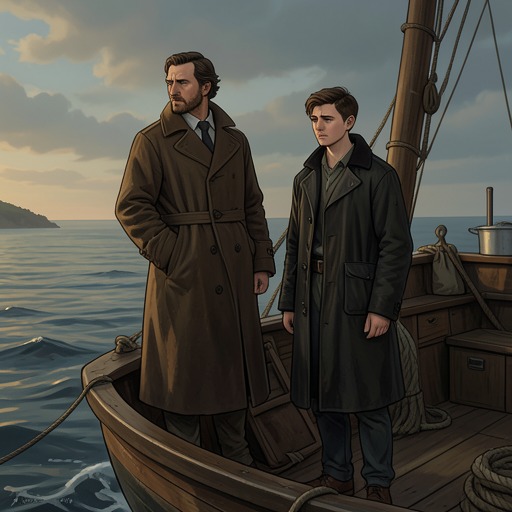
Caspian X and Prince Rilian
The Silver ChairCaspian X and Prince Rilian are father and son, joined by a bond that the prince’s disappearance leaves painfully unresolved. Their relationship gives the search for Rilian its dynastic stakes: Caspian is an aged king without another prince of his blood to succeed him, while Rilian is the missing heir whose fate is unknown to Narnia. When they are finally brought back into one another’s reach, Rilian’s first concern is whether his father is still alive.
Father, son, and the lost heir
Rilian is Caspian’s only son. The account of the prince’s disappearance presents that fact as a crisis for both family and kingdom: Caspian has no heir because his son was stolen away years earlier, and nobody in Narnia knows where the prince has gone or whether he survives. Aslan tells Jill Pole that Rilian is alive and charges her and Eustace Scrubb to seek him, making the recovery of Caspian’s son the purpose of their quest.
Rilian’s identity is not simply a matter of ancestry. He is named as the prince whose return would answer the old king’s lack of a successor, but the search begins without certainty that he can be found. The command to continue until he is brought to his father’s house, the searchers die in the attempt, or they return to their own world sets their family connection against the possibility of permanent loss.
The Queen’s death and Caspian’s grief
The story of Rilian’s loss begins with the death of his mother, Caspian’s queen. About ten years before the rescue, Rilian rode with her in northern Narnia. After a serpent attacked the queen, she died before she could deliver the message she had been trying to tell her son. The queen was carried back to Cair Paravel, where Caspian, Rilian, and all Narnia mourned her.
Her death affected Rilian profoundly. He repeatedly rode along Narnia’s northern marches, seeking the serpent in order to avenge his mother. About a month after the queen died, observers noticed a change in him: he returned from his wanderings looking tired and distracted, and seemed to have seen visions. This history places the eventual loss of Caspian’s son in the wake of a family bereavement. The evidence establishes the succession of these events, though it does not say that Caspian knew what happened to Rilian during his later absences.
Ten years of separation
By the time Rilian is freed from the enchantment that had obscured his identity, more than ten years have passed since he was lost in the woods on the north side of Narnia. The length of the separation becomes clear through Rilian’s question about how long he had been under the witch’s power. He remembers his enchanted life only after recovering his sense of self; while under the spell, he could not remember who he truly was.
The interval is also measured against Caspian’s age and circumstances. Rilian learns that his father sailed east again before the searchers left Narnia, and Puddleglum warns that Caspian is very old and may die on the voyage. The news turns reunion from a certainty into an urgent hope: Rilian has recovered his identity, but does not know whether his father remains alive to receive him.
Recognition and the hope of reunion
When Rilian sees Puddleglum, he recognizes him as a Marsh-wiggle and immediately asks whether he had forgotten Narnia while under the spell. He then declares himself Caspian’s son and the Prince of Narnia. The declaration marks the return of the identity that the enchantment had concealed, and it restores the father-son relationship to the center of the scene.
Rilian acknowledges that he owes Puddleglum, Jill, and Eustace a debt he cannot repay, but his next question is about Caspian: he asks whether his father is still alive. The response offers no assurance. Caspian has gone east, and his advanced age makes his survival uncertain. Thus the evidence closes on separation still unresolved: Rilian has been found and knows who he is, but at this point he does not yet know whether he will see his father again.
The relationship’s role in the story
The relationship links a personal recovery to the future of Narnia. Rilian’s disappearance is at once the loss of a son and the loss of the aged king’s only known heir; the quest therefore carries both family and political consequences. Aslan’s assurance that the prince lives gives the search a definite object, while the decade-long absence and Caspian’s final voyage make the eventual reunion uncertain rather than automatic.
The narrative reveals the father-son bond in stages. At first, Caspian is described through the vacancy left by his missing son; only after Rilian is rescued does the prince speak directly of his father and ask whether he survives. That ordering makes the question of reunion the emotional measure of Rilian’s return to himself: his name and royal status are restored, but the family bond cannot be completed until he reaches Caspian.